
Business automation has entered a new era with the rise of AI automation tools. In Tier-1 countries like the United States, United Kingdom, Canada, Australia, and Europe, enterprises are rapidly adopting artificial intelligence to automate workflows, reduce operational costs, and scale faster than ever before.
Unlike traditional automation, AI-powered automation goes beyond rule-based tasks. It learns, adapts, and optimizes processes over time, making it one of the highest ROI technology investments available today.
What Is Business Automation with AI?
Business automation using AI refers to the use of artificial intelligence technologies—such as machine learning, natural language processing (NLP), robotic process automation (RPA), and predictive analytics—to automate complex, repetitive, and decision-based tasks.
AI automation tools can:
- Analyze large volumes of data
- Make intelligent decisions
- Adapt to changing inputs
- Operate continuously without fatigue
This makes them significantly more powerful than traditional automation software.
Why AI Automation Tools Are in High Demand
Businesses in high-CPC markets prioritize automation because:
- Labor costs are high
- Efficiency directly impacts profitability
- Customer expectations are increasing
- Competition is global and intense
AI automation tools solve these challenges by delivering speed, accuracy, and scalability.
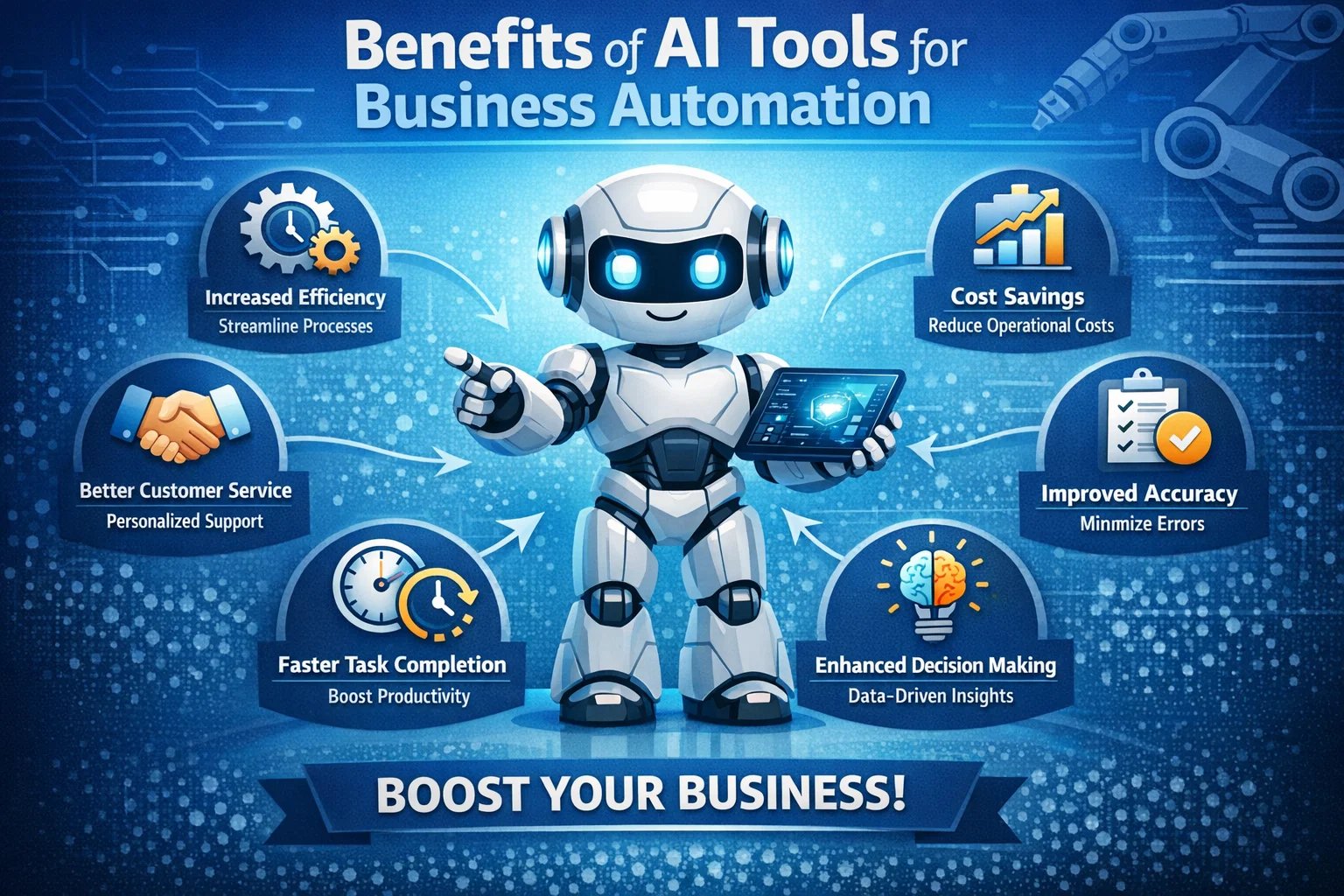
Key Benefits of AI Tools for Business Automation
1. Significant Cost Reduction
AI automation reduces dependency on manual labor by automating repetitive tasks such as data entry, invoice processing, payroll, and reporting.
- 30–60% reduction in operational costs
- Lower error-related expenses
- Reduced overtime and staffing needs
2. Increased Operational Efficiency
AI tools work 24/7 without breaks, delays, or fatigue, enabling faster turnaround times and consistent output quality while eliminating operational bottlenecks.
3. Improved Accuracy and Reduced Errors
Manual processes are prone to human error. AI automation tools minimize mistakes, enforce compliance, and maintain consistent execution—especially valuable in finance, healthcare, and legal sectors.
4. Scalability Without Proportional Cost Increase
AI automation allows businesses to handle higher workloads, expand globally, and support rapid growth without increasing headcount at the same rate.
5. Faster and Smarter Decision-Making
By analyzing real-time data and generating insights, AI tools help businesses respond to market changes, optimize pricing and inventory, and improve forecasting accuracy.
Common Business Processes Automated Using AI
Customer Support Automation
AI chatbots and virtual assistants handle queries instantly, reducing response times and support costs.
Finance and Accounting Automation
Invoice processing, fraud detection, forecasting, and expense management become automated and accurate.
Marketing Automation
AI improves ad targeting, personalization, segmentation, and campaign optimization.
Sales Automation
Lead scoring, follow-ups, forecasting, and CRM updates are managed automatically.
HR and Recruitment Automation
Resume screening, interview scheduling, engagement analysis, and attrition prediction are streamlined with AI.
AI Automation vs Traditional Automation
| Feature | Traditional Automation | AI Automation Tools |
|---|---|---|
| Decision Making | Rule-based | Data-driven and adaptive |
| Learning Ability | None | Continuous learning |
| Scalability | Limited | Highly scalable |
| Error Handling | Manual intervention | Self-correcting |
Industries Benefiting Most from AI Automation
- Banking and Finance: Risk assessment, fraud detection, compliance automation, and trading.
- Healthcare: Scheduling, diagnostics, billing, and medical record management.
- E-commerce: Order processing, inventory control, dynamic pricing, and recommendations.
- Manufacturing: Predictive maintenance, quality assurance, and supply chain optimization.
- IT and SaaS: Monitoring, DevOps automation, onboarding, and incident response.
Why AI Automation Tools Have High CPC and eCPM
AI automation keywords attract premium advertisers because enterprise buyers have large budgets, long customer lifetime value, strong Tier-1 demand, and recurring SaaS revenue potential—making this niche highly profitable for digital publishers.
Challenges of AI Business Automation
- High initial setup cost
- Dependence on quality data
- Integration with legacy systems
- Organizational change management
Despite these challenges, long-term gains significantly outweigh short-term obstacles.
Future of AI Automation in Business
- Enterprise-wide hyperautomation
- Autonomous decision-making systems
- AI-driven business intelligence
- Human-AI collaborative workflows
Early adopters will gain dominant competitive advantages.
Final Thoughts
AI automation tools are transforming business operations by improving efficiency, reducing costs, and enabling scalable growth. In competitive Tier-1 markets, AI-driven automation is no longer optional—it is a strategic necessity.
Organizations that implement AI automation today position themselves for long-term profitability, innovation, and sustained market leadership.